
How to search for a chess position
Searching for a specific chess position is one of the most powerful ways to improve your chess. Instead of memorizing long variations, you focus on ideas, plans, and typical structures that appear repeatedly in real games. In this article, you’ll learn how to search for a chess position in Chesspertise and how to use the results for practical improvement.
12/27/20253 min read
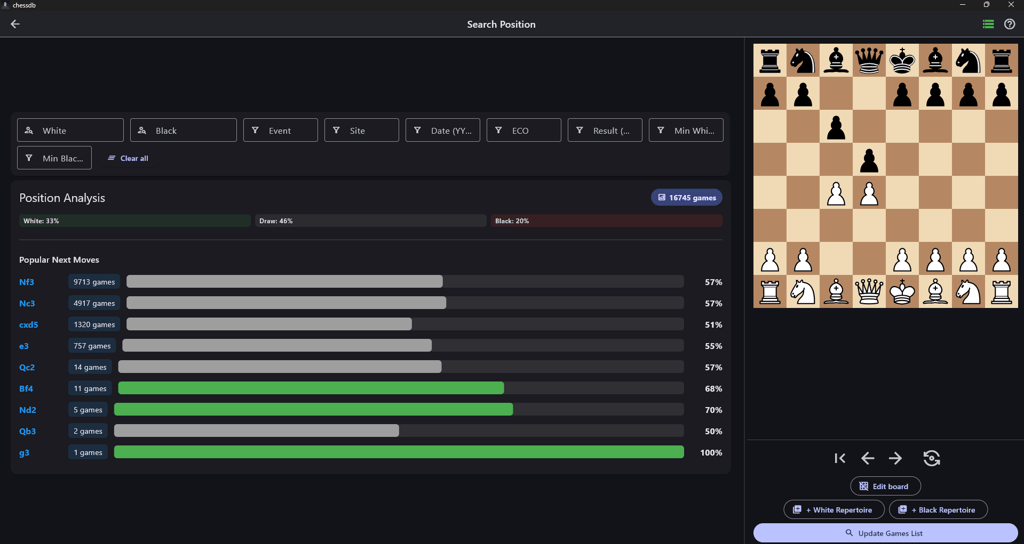
Searching for a specific chess position is one of the most powerful ways to improve your chess.
Instead of memorizing long variations, you focus on ideas, plans, and typical structures that appear repeatedly in real games.
In this article, you’ll learn how to search for a chess position in Chesspertise and how to use the results for practical improvement.
Why Position-Based Search Is So Important
Most players search databases by:
opening name
move order
player name
While useful, this approach has a major limitation:
the same position can be reached through many different move orders.
Position-based search allows you to:
study typical middlegame structures
understand plans for both sides
find model games in your openings
prepare against opponents more effectively
This is how strong players actually use databases.
What Does “Searching a Position” Mean?
Searching for a position means:
defining a board position (pieces, side to move)
asking the database to find all games where that position occurred
analyzing what strong players did from that point onward
In Chesspertise, this is fast and intuitive because positions are indexed, not just move.
Step-by-Step: How to Search for a Chess Position in Chesspertise
1. Click on search
From the Chesspertise home page:
click on Search Position
at the top right there is a green icon, click on it and select the database you want to use for this search
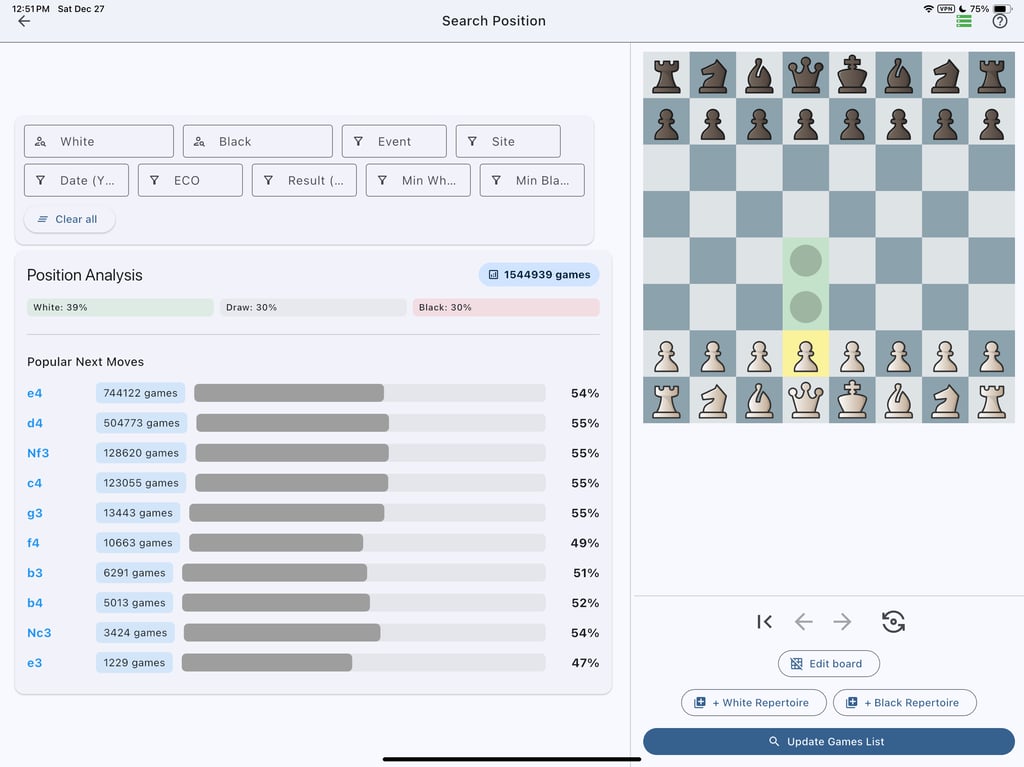
In the example above, I am using a database from Opening Master (www.openingmaster.com), which I highly recommend for the quality of the games and the excellent value for money.
The strength and cleanliness of the database you use is extremely important. Strong players and serious playing conditions produce far better material for study.
Setting Up a Position on the Board
Once you have selected the database you want to use, you can start defining a position using the chessboard on the right side of the screen.
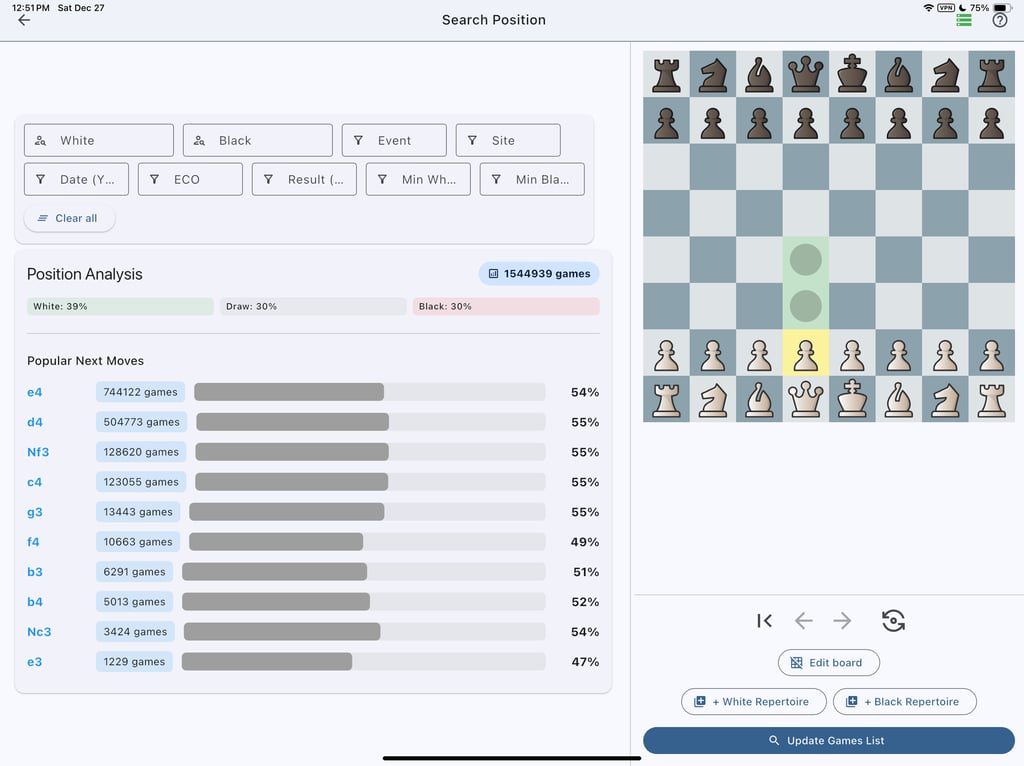
When you click on a piece, Chesspertise highlights all legal moves for that piece.
This allows you to replay moves naturally until you reach the exact position you are looking for.
Editing the Board Manually
There is also another way to search for a specific position:
Click the Edit Board button just below the chessboard
Manually place any pieces on the board
Start the position search
Understanding Position Statistics
For every searched position, Chesspertise provides important statistical data:
Win percentage for White
Win percentage for Black
Draw percentage
Overall White score for each continuation
These statistics help you quickly evaluate whether a line is:
promising
playable
risky
or strategically questionable
They should be used as guidance, not as absolute truth.
Why Database Quality Matters
As you can see, the quality of the database is crucial.
For serious improvement:
stronger players produce better strategic examples
OTB long games are generally superior to blitz or online rapid
modern, well-curated databases give more reliable evaluations
This is why database selection matters as much as the search itself.
Exploring the Games Behind the Position
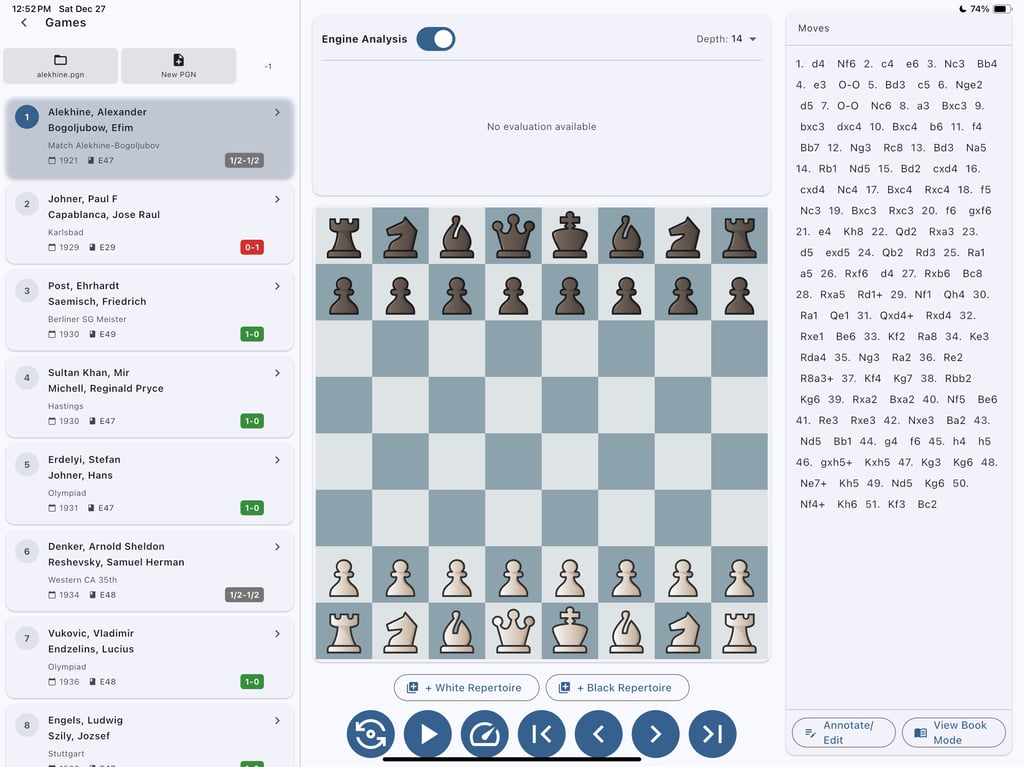
Once you have selected a specific line, click the blue button below the chessboard labeled Update Games List.
You will be taken to a new page where you can:
analyze every game that reached the selected position
replay full games move by move
annotate and save important examples
The games are sorted by date, which is important if you want to:
understand how a line originated
study how theory evolved over time
see which ideas are still relevant today
Summary
Searching for a chess position is one of the most effective ways to understand plans, structures, and typical ideas beyond memorizing moves. Using a high-quality database is essential, as stronger players and serious playing conditions produce more reliable and instructive games.
With Chesspertise, you can define a position directly on the board or by editing it manually, instantly access statistical results, and explore how strong players have handled the position over time. By analyzing the resulting games—especially high-level OTB games—you turn raw data into practical chess knowledge that directly improves your decision-making at the board.
Contact
info@chesspertise.app
© 2025. All rights reserved.
Chesspertise
Legal
Chesspertise
About